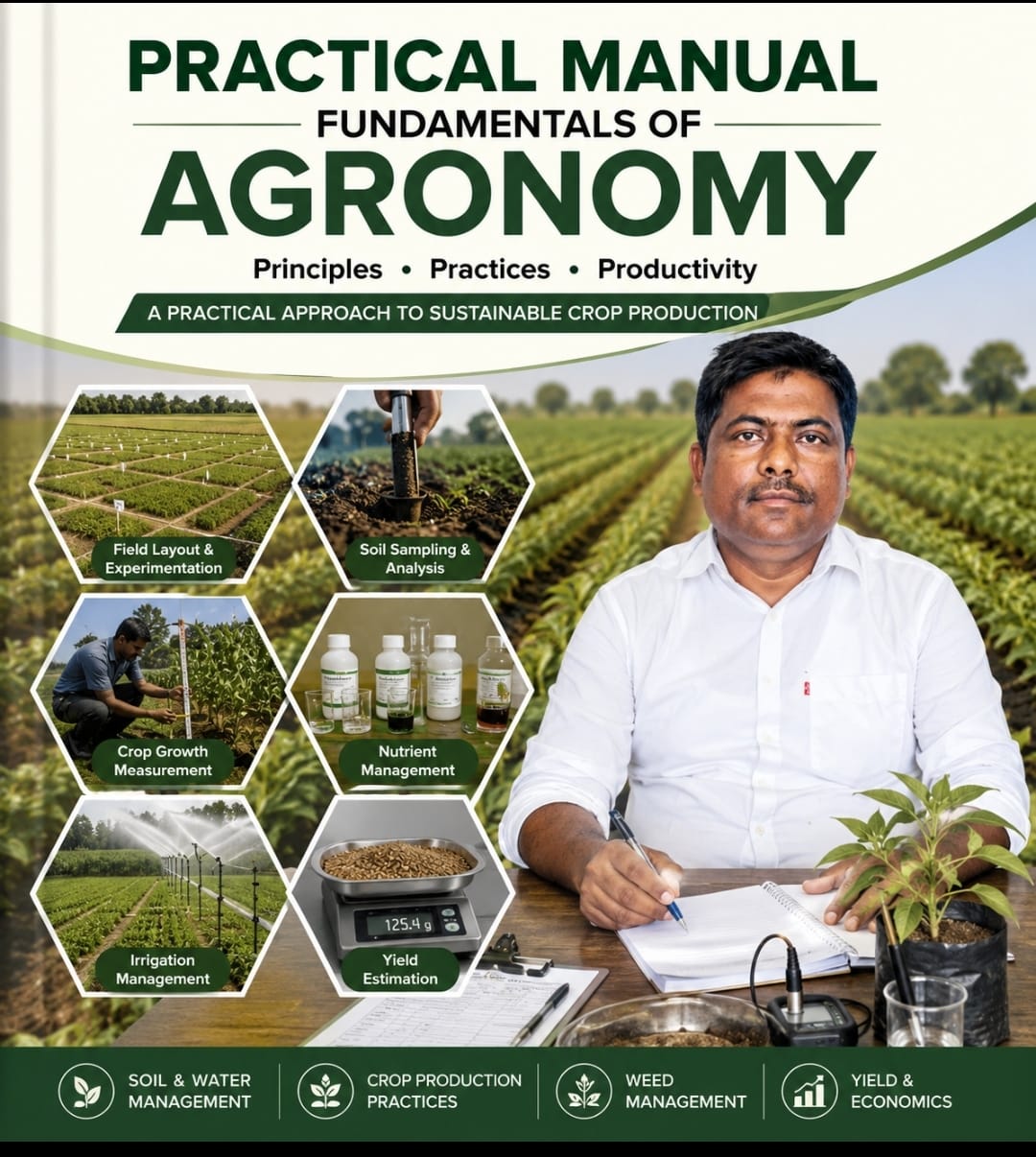
Fundamentals of Agronomy (AG 101): Practical Manual for Agriculture Students
Fundamentals of Agronomy (AG 101)
The Fundamentals of Agronomy (AG 101) Practical Manual is designed for B.Sc. (Hons.) Agriculture students to develop practical knowledge of agronomic principles and field operations. It provides laboratory and field-based experiments that help students understand crop production, soil management, seed technology, irrigation, and farm implements.
Practical Experiments Covered
This practical manual includes the following important experiments:
- Study of various crops, botanical names, families, and growing seasons
- Identification of crops, seeds, fertilizers, and pesticides
- Identification and use of tillage implements
- Effect of sowing depth on seed germination and seedling vigour
- Yield contributing characters and crop yield estimation
- Seed germination and viability testing
- Numerical exercises on fertilizer requirement
- Plant population and crop water requirement calculations
- Use of seed drills, harrows, levellers, and ploughs
- Study of soil moisture measuring devices
- Measurement of field capacity, bulk density, and infiltration rate
- Measurement of irrigation water and discharge calculations
Key Learning Outcomes
After completing this practical manual, students will be able to:
- Identify major agricultural crops and their botanical classification.
- Recognize fertilizers, pesticides, and tillage implements.
- Perform seed germination and viability tests.
- Calculate fertilizer doses, plant population, and irrigation requirements.
- Measure soil moisture, field capacity, infiltration rate, and irrigation water.
- Estimate crop yield using standard agronomic methods.
Conclusion
The Fundamentals of Agronomy (AG 101) Practical Manual provides hands-on training in essential agronomic practices. It strengthens students' understanding of crop production, soil management, irrigation techniques, and field experimentation, helping them build a strong foundation for modern agriculture.